

- Alternative provision (AP) describes education outside mainstream schools for children who are excluded, at risk of exclusion, or unable to attend due to health or well-being needs
- AP settings range from Pupil Referral Units and hospital schools to therapeutic environments, vocational training providers, and specialist SEMH facilities
- The built environment plays a crucial role in supporting AP students, with thoughtful design helping to reduce anxiety and improve engagement
- Local authorities have a statutory duty under Section 19 of the Education Act 1996 to arrange suitable education for children who cannot attend mainstream school
- Purpose-built AP facilities can include features like sensory rooms, therapeutic intervention spaces, and flexible layouts that adapt to individual needs and support multi-disciplinary teams
Alternative provision is a term you’ll encounter across the UK education sector, yet its meaning and scope aren’t always clearly understood.
Put simply, AP refers to education that takes place in general outside mainstream school buildings, serving children and young people who, for various reasons, aren’t able to thrive in a traditional classroom environment.
This might be due to permanent exclusion, health conditions, mental health challenges, or behaviour that’s proving difficult to manage within mainstream structures. Whatever the reason, AP exists to ensure these young people continue to receive an education suited to their circumstances.
This guide explores what alternative provision involves, the different types of settings available across the UK, and why purpose-built environments matter so much for the children who attend them. We’ll also look at how specialist buildings can support therapeutic approaches and help students re-engage with learning.
Understanding Alternative Provision and Its Legal Framework
Alternative provision covers any education arranged for children who aren’t attending a mainstream school. This can mean full-time education at a dedicated AP setting, part-time placements across multiple providers, or a combination of approaches tailored to individual needs.
The legal foundation for AP comes from Section 19 of the Education Act 1996, which places a statutory duty on local authorities to arrange suitable, full-time education for children of compulsory school age who cannot attend school or college due to exclusion, illness, or other reasons. This means that when mainstream school isn’t working, local authorities must ensure appropriate education continues. The Department for Education provides statutory guidance on alternative provision that sets out what schools and local authorities must do to comply with the law.
AP typically supports children who have been permanently excluded from school, are at risk of exclusion due to behaviour concerns, cannot attend due to physical health conditions, struggle with mental health challenges such as anxiety or depression, or experience Emotionally Based School Absence (EBSA).
It’s worth noting that alternative provision isn’t the same as special educational needs (SEND) provision, though there’s considerable overlap. Many children in AP do have SEND, but AP focuses on the setting and circumstances rather than specific learning needs. A child might have an Education, Health and Care Plan (EHCP) and attend alternative provision, or they might be in AP without any identified special needs. The SEND Code of Practice: 0 to 25 years provides detailed guidance on how EHCPs work alongside alternative provision.
Types of Alternative Provision Settings
Alternative provision isn’t a single type of setting. The approach that works best depends entirely on individual circumstances, needs, and goals.
Pupil Referral Units (PRUs)
PRUs are the most common form of alternative provision in the UK. Run by local authorities, they typically cater for children who have been excluded or are at risk of exclusion. PRUs offer smaller class sizes than mainstream schools, with more structured environments and additional support. Most aim to help students reintegrate back into mainstream education, though some pupils remain longer-term.
Hospital Schools and Medical AP
For children with health conditions that prevent school attendance, hospital schools and medical alternative provision maintain educational progress during treatment. These settings often work closely with NHS services, adapting learning around medical appointments, procedures, and recovery periods.
Therapeutic and Specialist SEMH Settings
These settings address mental health and emotional needs alongside academic learning. They might include outdoor education centres, forest schools, or programmes offering therapeutic approaches. Since the pandemic, demand has grown significantly for settings supporting children with Emotionally Based School Absence and anxiety-related difficulties.
Students with Social, Emotional, and Mental Health (SEMH) needs make up a significant proportion of the AP population. Quality providers recognise that emotional well-being must come before academic progress, offering smaller class sizes, access to counselling or therapy, and staff trained in trauma-informed approaches.
Vocational Training Providers
For older students, typically aged 14 to 18, vocational providers offer practical, skills-based learning. Courses might cover construction, catering, hair and beauty, mechanics, or other trades. This hands-on approach can re-engage young people who’ve struggled with traditional academic settings.
Why the Built Environment Matters in Alternative Provision
The physical environment in which AP takes place significantly influences outcomes. For vulnerable learners who may have experienced trauma, exclusion, or prolonged anxiety, the spaces around them can either support recovery or create additional barriers.
Research consistently shows that thoughtful building design can reduce stress, improve concentration, and help students feel safe enough to engage with learning again. This is why many AP providers are investing in purpose-built facilities rather than adapting existing spaces.
Features that support AP students include natural light through generous glazing, which helps regulate circadian rhythms and improve mood. Acoustic treatment is equally important, as many children in AP have sensory processing difficulties and find echoey spaces overwhelming. Easy access to outdoor spaces provides opportunities for movement and connection with nature, while flexible layouts allow rooms to adapt for different activities and group sizes.
The principles of biophilic design are particularly relevant in AP settings. By incorporating natural materials, views of greenery, and strong connections between indoor and outdoor spaces, buildings can create calming environments that support emotional regulation.
Creating Specialist Spaces for SEMH and Therapeutic Provision
When designing or commissioning AP facilities, providers increasingly recognise the need for specialist spaces beyond standard classrooms.
Sensory rooms offer quiet retreats where students can regulate their emotions when feeling overwhelmed. Therapeutic intervention spaces provide appropriate settings for counselling, occupational therapy, or one-to-one support. Breakout areas give students somewhere to work independently or in small groups away from the main classroom. Small kitchens support life skills development and can encourage independence.
The flexibility to adapt spaces as needs change is also valuable. Student cohorts in AP settings can vary significantly year to year, and buildings that allow rooms to be reconfigured support this reality.
Case Study: SEMH Building at Mountfield Heath

Eco Building for SEMH at Mountfield Heath
Mountfield Heath is a relatively new 3 ½ year old school for students aged 5-11 with some complex and challenging needs. An SEMH Independent Special...
Mountfield Heath is an independent special school in Kent for students aged 5-11 with complex and challenging needs. Facing increasing demand for placements from across a 50-mile catchment area, they needed to expand capacity while maintaining their therapeutic approach.
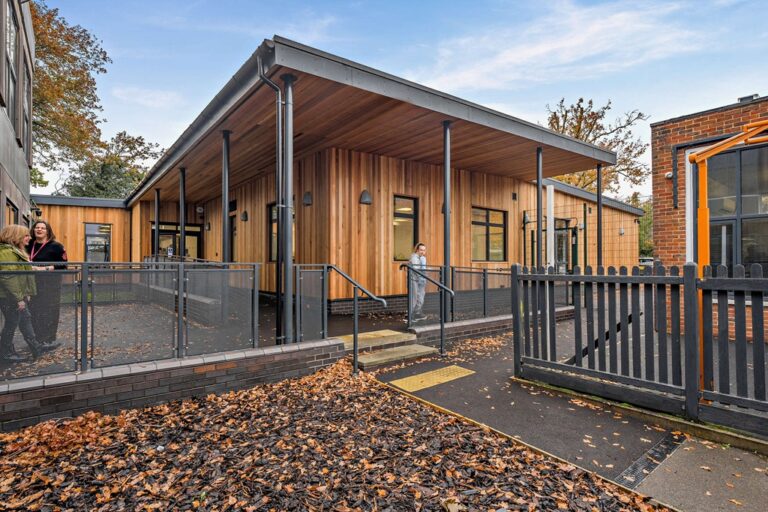
Working with TG Escapes, the school created a specialist SEMH building containing two classrooms alongside dedicated therapeutic spaces. The building includes a sensory room, two therapeutic intervention areas, and a small kitchen to encourage independent living skills.
Executive Headteacher Lyndsey Jefferies explained how the design evolved: “Originally, it was going to be three classrooms and then, because of our changed needs, TG Escapes were able to react and we partitioned one of the classrooms to create a therapeutic space and a sensory room.”
The building’s design reflects the school’s rural setting. “It feels very bright and airy, and because we are in quite a rural area, it really is in keeping with the woodland, the trees and the fields,” noted Jefferies. “The natural materials change the feel of it, and for a modular build, it feels really solid and robust.”
Crucially, the building supports the school’s therapeutic model. “What works very well are the verandas. Having the decking coming straight off the front, that indoor/outdoor space works very well with our children.” The acoustic treatment also makes a difference: “Although many modular builds are very echoey, ours is not because of the ceiling tiles.”
Case Study: Intervention Space at Rabbsfarm Primary School

Eco-classroom for Alternative Provision at Rabbsfarm Primary School in West Drayton
Rabbsfarm Primary School wanted an alternative provision for children with additional needs.
Not all alternative provision happens in dedicated AP schools. Mainstream schools increasingly need spaces where children with additional needs can receive targeted support before being reintegrated into regular lessons.
Rabbsfarm Primary School in West Drayton worked with TG Escapes on an AP classroom designed specifically for this purpose. The school explained: “We needed to provide an extra space for our children who have particular needs, enabling us to withdraw these children for short periods and then reintegrate them into class.”
The flexibility of the space was a key factor: “It offered a space which fitted in with our present building and provided flexibility in the way it could be used.”
This type of provision, sometimes called a nurture room or intervention space, allows mainstream schools to support children who might otherwise be at risk of exclusion. By providing a calm, purpose-designed environment for short-term withdrawal, schools can help students develop coping strategies and build skills before returning to their regular classroom.
Key Considerations When Planning AP Buildings
Whether expanding an existing AP setting or creating new provision, several factors influence successful outcomes.
Student needs should drive design. The specific requirements of the students a setting serves should inform every design decision. An SEMH facility will have different priorities than a PRU focused on reintegration to mainstream, which will differ again from vocational training provision.
Flexibility supports changing cohorts. AP populations can change significantly year to year. Buildings that offer adaptable spaces rather than fixed layouts provide long-term value.
Outdoor access matters. Many AP students benefit enormously from time outdoors. Covered verandas, secure outdoor areas, and strong visual connections to nature all support wellbeing.
Acoustic and sensory considerations. Given the high proportion of AP students with sensory processing differences, acoustic treatment and careful lighting design are essential, not optional extras.
Location within the site. Where possible, AP buildings benefit from some separation from busier areas of a campus, providing a quieter environment while still allowing connection to the wider school community.
Understanding how tailored environments benefit SEND students can help inform these planning decisions.
What Happens After Alternative Provision?
For many children, AP is a stepping stone rather than a destination. With appropriate support and the right environment, many students successfully reintegrate to mainstream school, transition to further education at college or sixth form, or move into vocational pathways and apprenticeships.
The key to positive outcomes is recognising that each young person’s journey is different. Some will spend just a few weeks in AP as a circuit-breaker before returning to mainstream with new strategies in place. Others will remain in specialist provision throughout their school years, thriving in environments designed around their needs.
Quality AP providers plan for transitions from the start, maintaining connections with mainstream schools where reintegration is the goal, and building links with colleges and employers where other pathways are more appropriate.
Frequently Asked Questions
Is alternative provision the same as a Pupil Referral Unit?
No. PRUs are the most common type of alternative provision, but AP encompasses many other settings, including hospital schools, therapeutic provisions, vocational training centres, and specialist SEMH facilities. The right type depends on individual circumstances and needs.
Can mainstream schools have alternative provision?
Yes. Many mainstream schools create internal AP through intervention rooms, nurture spaces, or dedicated SEN units. These allow children to receive targeted support while remaining part of their school community. Some schools commission bespoke SEND and SEMH classrooms specifically for this purpose.
How long do children typically stay in alternative provision?
This varies enormously, from a few weeks to several years. Some placements are short-term interventions designed to help a child return to mainstream quickly. Others are longer-term, where AP becomes the child’s main educational setting until they move to college or employment.
What qualifications can students achieve in alternative provision?
Most AP providers offer GCSE courses in core subjects like English and Maths, though the range of subjects may be more limited than in mainstream schools. Vocational AP settings often provide practical qualifications and pathways into apprenticeships.
Why does the building design matter so much in AP settings?
Children in alternative provision have often experienced trauma, exclusion, or prolonged anxiety. The physical environment can either support recovery or create additional stress. Purpose-built spaces with natural light, good acoustics, flexible layouts, and outdoor access help students feel calm enough to learn.
Creating Environments Where Vulnerable Learners Can Thrive
Alternative provision serves some of the most vulnerable young people in our education system. These are children who, for various reasons, haven’t been able to succeed in mainstream classrooms, whether due to exclusion, health challenges, anxiety, or other circumstances.
Getting the built environment right makes a genuine difference to outcomes. When students feel safe, calm, and connected to nature, they’re better placed to engage with learning, develop coping strategies, and make progress towards their goals.
At TG Escapes, we’ve worked with schools, trusts, and local authorities across the UK on modular classrooms and specialist facilities designed around the needs of vulnerable learners. From small intervention spaces in mainstream primaries to dedicated SEMH buildings in specialist settings, each project starts with understanding who will use the space and what they need to thrive.
If you’re planning alternative provision facilities and would like to discuss how purpose-built environments can support your students, we’d be happy to help. Every project begins with a free design consultation where we can explore your specific requirements and site.

What is Bulletin 104? A Complete Guide to SEND Building Guidelines
 Christopher Leese